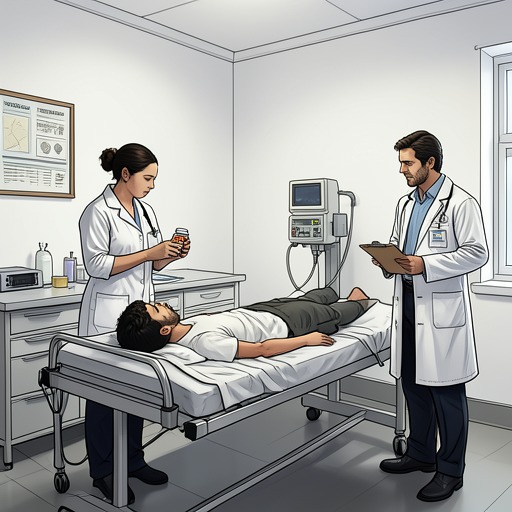
McMurphy’s repeated electroshock treatments
One Flew Over the Cuckoo's NestRandle Patrick McMurphy’s repeated electroshock treatments expose the ward’s central contradiction: treatment is presented as a route back to health, yet it is also used to punish resistance and demand submission. McMurphy refuses to provide the remorse Nurse Ratched seeks, making each return to the treatment room another public test of who controls his body and conduct. His jokes help the other patients endure the spectacle, but the strain showing in his face makes clear that defiance does not leave him untouched.
Treatment as Discipline
The threat of electroshock is established as part of the ward’s disciplinary system before McMurphy receives the repeated treatments. When Maxwell Taber challenges the medication routine, Nurse Ratched tells him he may leave rather than take his medicine orally. The ward’s black aides then seize him in the latrine, drag him to a mattress room, and hold him down while a nurse prepares a long needle. Taber curses and struggles; afterward, his clothes are torn and he is carried across the hall wrapped in a damp sheet. The scene shows how a patient’s refusal can be met with force before any treatment is described as beneficial.
McMurphy also learns that open hostility can bring serious consequences. Fredrickson explains that patients labeled potentially assaultive may be sent upstairs to the Disturbed Ward, where they lose privileges such as going to the Saturday movie. He warns that continued defiance could lead to the Shock Shop and even an operation. This makes electroshock part of a wider continuum of institutional control: the prospect of treatment hangs over conduct, while the possibility of a more permanent intervention sharpens the threat.
The Treatment Room and the First Demand
Three weeks after the patients’ vote over television, Chief Bromden recalls being sent with the others to Building One under the stated pretext of chest X-rays. The line passes an X-ray door and a separate, unmarked metal door. From the bench, patients can hear a man screaming inside the treatment room. When it opens, Bromden sees illuminated tubes and a patient wheeled out smoking. Another man, drugged after receiving red capsules, is dragged toward the room; for a moment he braces both heels against the cement, stiffening as he realizes where he is being taken. The door shuts with a heavy impact. The clinical procedure is encountered not through explanation but through its sounds, equipment, and frightened bodies.
McMurphy watches the last patient taken inside and asks whether electricity is being sent through a person’s skull. The concise description does not reassure him; he wants to know what the treatment is for. His question brings the procedure out from behind its institutional name and into the plain physical act that the patients have witnessed. In this setting, the treatment room’s unmarked door and the patients’ enforced waiting make the process seem less like a voluntary consultation than a hidden extension of ward authority.
The immediate demand placed on McMurphy comes after he has thrown a tantrum. Nurse Ratched addresses him in front of a watching circle of patients, calling his conduct irresponsible and childish and asking whether he is ashamed. She says that at a special group meeting the previous afternoon, the patients and staff agreed that shock therapy might benefit him. The offer to cancel it is conditional: he must admit he was wrong and demonstrate rational contact. McMurphy declines to give the admission she is asking for. The meeting thus frames treatment as dependent not simply on a medical procedure, but on his willingness to accept the ward’s account of his behavior.
Repetition, Performance, and Fear
The pressure continues through three more treatments that week. As soon as McMurphy begins to recover from one, Nurse Ratched arrives with the doctor and asks whether he is ready to face his problem and return to the ward for a cure. Each time, McMurphy answers with a deliberately defiant performance, invoking sacrifice for his country and telling her she cannot make him give up the ship. The other men on the Disturbed Ward turn toward him and grin; he bows to them before Nurse Ratched takes the doctor aside to authorize another treatment. His resistance is not private: it gives the waiting patients a spectacle in which the threatened man continues to answer back.
Once, as Nurse Ratched turns away, McMurphy pinches her through the back of her uniform, reddening her face. The gesture reverses the immediate balance of the encounter, and the doctor appears to hide a grin. But the reversal does not stop the procedure. Nurse Ratched still has the doctor authorize another treatment, so the small act of retaliation can embarrass her without taking the treatment decision out of her hands.
McMurphy tells Chief Bromden that the shocks are merely charging his battery and insists they are not hurting him. He refuses to take his capsules, and he jokes that he will emerge from the treatments more powerful. Yet Bromden observes a different response when the loudspeaker calls McMurphy to miss breakfast and walk to Building One: his jaw muscles tighten, his face drains of color, and he looks thin and frightened. That expression recalls the face Bromden had seen reflected in the windshield on the trip back from the coast. McMurphy’s bravado is therefore neither proof of invulnerability nor a simple disguise that erases fear; the story places his joke beside the involuntary signs of what the repeated summons cost him.
Aftermath and Significance
Bromden’s own experience supplies a contrast, not a measure of McMurphy’s recovery. After earlier shock treatments, Bromden says he sometimes wandered for as long as two weeks in a confused, foggy state; this time he fought his way out in less than a day. The account makes recovery uneven and intensely personal. When Bromden returns from the Disturbed Ward at the end of the week, McMurphy has just come back from a treatment and follows a ping-pong ball with his eyes. Other patients ask what has happened to him and repeat rumors that he is being treated every day and shrugging it off. Bromden can report their questions and the rumors, but they do not establish that McMurphy feels no effects.
The repeated shocks belong to an escalation that ultimately goes beyond electroshock. After McMurphy has been absent for three weeks, the ward’s black aides wheel a gurney into the day room bearing a chart marked post-operative and identifying a lobotomy. The other patients read the chart and look at his bruised, pale face. The novel distinguishes this later operation from the shock treatments, but places them within the same struggle over who can define and alter McMurphy’s behavior. His comic refusal keeps the treatment scenes from becoming a story of silent compliance; the visible fear, recurring calls, and eventual return on a gurney show the limits of that resistance against an institution able to repeat its procedures and determine their terms.